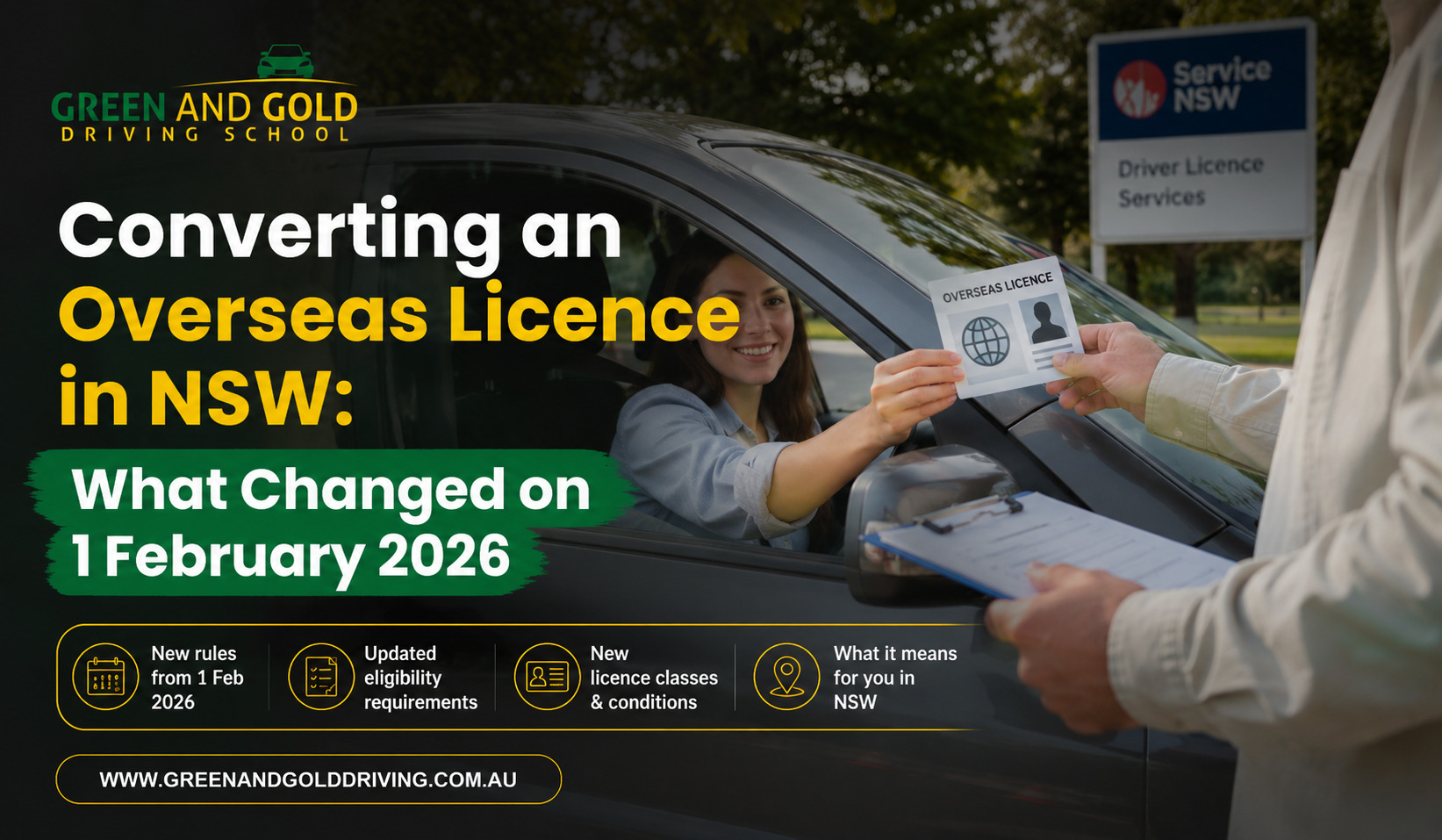
If you have moved to Australia and hold a licence from overseas, the rules for converting it to a NSW licence changed significantly on 1 February 2026.
For thousands of drivers across Sydney, including many families settling in Castle Hill and the Hills District, the change means something concrete. A conversion that used to be a paperwork exercise now involves sitting a knowledge test and a full driving test.
Here is what changed, who it affects, and what to do about it.
What Experienced Driver Status was, and why it matters that it is gone
Until recently, NSW recognised a category sometimes called Experienced Driver Status. Drivers aged 25 or over holding a licence from certain countries could convert to a NSW licence without sitting any tests, even though their country was not on the main recognised list.
That pathway ceased in NSW on 1 February 2026, as part of a national policy review coordinated through Austroads.
The practical effect is simple. If your country relied on that arrangement, your licence is now treated the same as any other non-recognised licence. Knowledge test, driving test, both required.
Countries commonly affected include Poland, South Korea, Hong Kong, Taiwan, South Africa, Serbia, Bulgaria, Romania, Hungary, Czechia, Slovakia, Slovenia, Estonia, Latvia, Lithuania and Cyprus.
If you converted a licence in NSW before February 2026, nothing changes for you. This affects new applications only.
The recognised countries list
You can convert a car or rider licence without sitting tests if your licence was issued in one of these places:
Austria, Belgium, Bosnia and Herzegovina, Canada, Croatia, Denmark, Finland, France, Germany, Greece, Guernsey, Ireland, Isle of Man, Italy, Japan, Jersey, Luxembourg, Malta, Netherlands, New Zealand, Norway, Portugal, Singapore, Spain, Sweden, Switzerland, the United Kingdom, and the United States.
Some conditions apply across the board:
- The licence must be current, or expired within the last five years
- It cannot be a learner licence
- Paper New Zealand licences do not qualify
- Some jurisdictions have date qualifiers, such as Isle of Man licences issued since April 1991 and Malta licences issued or renewed since January 2004
- Licences from external territories of a listed country are not covered
If your country is not on that list, you will need to pass a knowledge test and a driving test.
One important exception in the other direction: heavy vehicle licences have no exemptions at all. If you are applying for LR, MR, HR, HC or MC, you must sit the relevant tests regardless of where your licence came from.
How long you have
Your deadline depends on your status, not on your country.
Permanent residents, Australian citizens and New Zealand licence holders have three months from when you begin living in NSW.
Temporary visa holders who arrived after 1 July 2023 can drive on their overseas licence for six months. To keep driving beyond that, you need a temporary NSW licence. It carries a Q condition on the card, noting that permanent residency was not established. If you later gain permanent residency or citizenship, that condition can be removed at a service centre.
Three months arrives faster than people expect when you are also finding housing, schools and work. If you are on the tested pathway, starting early matters, because you need time to prepare rather than just time to book.
What you need to bring
Whichever pathway applies, gather:
- The Licence Application form
- Proof of identity documents
- Your original overseas licence
- An approved English translation, if your licence is not in English
- Payment
On translations, be careful here. Transport for NSW only accepts translations from a short list of approved sources: Multicultural NSW, the Department of Home Affairs, the Consulate-General of the Republic of Korea for Korean licences, and the Taipei Economic and Cultural Office for Taiwanese licences.
A translation from a private agency or a friend who speaks both languages will be rejected, and people lose weeks to this. If you cannot produce your original licence, you need an authorisation letter in English from the issuing country’s embassy, consulate or government department.
If you now need to sit a driving test
Here is the good news for experienced drivers. If you are required to test, you are exempt from the learner logbook requirement. You do not need 120 hours, and you do not need to be supervised for a year. You prepare, you book, you sit the test.
The bad news is that being a skilled driver in another country does not automatically make you a skilled driver here, and NSW assessors are marking against a specific standard.
The gaps that catch experienced overseas drivers are rarely about car control. They are habits:
Observation. NSW assessors want to see a physical head check over your shoulder before every lane change, merge and pull out. Mirrors alone are not enough. In many countries this is not taught or assessed, so drivers with twenty years of experience simply do not do it, and it costs them the test.
Roundabouts. Direction of travel, lane selection and the requirement to signal left before every exit. If you learned to drive on the right, roundabouts run the opposite way and the instinct takes real practice to rewire.
Lane discipline. Keeping left unless overtaking, and the specific NSW give way rules at unmarked intersections.
Signs and line markings. Australian signage differs from European and Asian conventions in ways that are easy to underestimate.
Speed management. Assessors mark on whether your speed suits the conditions, not just whether you are under the limit.
Preparing efficiently
Most experienced drivers converting a licence do not need a long program. They need targeted correction of a handful of habits, then a rehearsal under test conditions.
That usually means a small number of focused sessions rather than a full learner course. An instructor sitting beside you will spot in ten minutes what you cannot see about your own driving in ten years.
A mock test run is particularly worthwhile here, because the format itself is unfamiliar even when the driving is not. It is also worth reading up on the faults that most commonly end a NSW driving test, since several of them are habits rather than errors.
Driving lessons for licence conversion in Castle Hill
If the February 2026 change means you now need to sit a NSW driving test, we can help you get there quickly.
We work with drivers who already have years of experience and simply need to adapt to NSW conditions, roads and assessment standards. That is a different job from teaching a beginner, and we treat it that way. Expect direct feedback, a focus on the specific habits assessors look for, and no time wasted on skills you already have.
Green and Gold Driving School
Call now: 0422 883 323 Book online: www.greenandgolddriving.com.au Visit us: 18 Victoria Avenue, Castle Hill NSW 2154, Australia
Frequently asked questions
I converted my licence in NSW before February 2026. Do I need to do anything now?
No. The change applies to new applications. A NSW licence already issued to you remains valid and is renewed in the normal way.
My country used to have Experienced Driver Status. Is there any way around the tests now?
Not through that pathway, as it no longer exists in NSW. The one remaining exemption that might apply is if you previously held an Australian licence that expired within the last five years and can be verified.
Can I keep driving while I prepare for the test?
Only within your legal window, which is three months for permanent residents and citizens, or six months for temporary visa holders who arrived after 1 July 2023. Beyond that you need a NSW licence, or a temporary NSW licence, to keep driving legally.
Do I need an International Driving Permit?
An IDP supports a visitor driving short term, but it does not extend your conversion deadline and it is not a substitute for a NSW licence once you are living here.
My licence is in another language. Who can translate it?
Only Transport for NSW approved sources. Multicultural NSW and the Department of Home Affairs handle most languages, with dedicated arrangements through the Korean Consulate-General and the Taipei Economic and Cultural Office for those two jurisdictions.
Will I be put on P plates after converting?
If you hold a full unrestricted overseas licence and meet the requirements, you are generally issued a full NSW licence rather than a provisional one. Your situation can differ depending on your age and licence class, so confirm at a service centre.
I have driven for fifteen years. How many lessons would I realistically need?
Far fewer than a beginner. Most experienced drivers need a small number of sessions focused on observation habits, roundabouts and NSW-specific rules, plus a mock test. The exact number depends on how different your home country’s road environment was.
What if I fail the NSW driving test?
You can rebook and sit it again. There is a mandatory waiting period between attempts and a fee for each one, so preparation is worth the investment.
Does my overseas driving experience count for anything?
Yes, in one important way. If you are required to test, you are exempt from the learner logbook hours requirement, which is the single biggest time saving in the whole process.