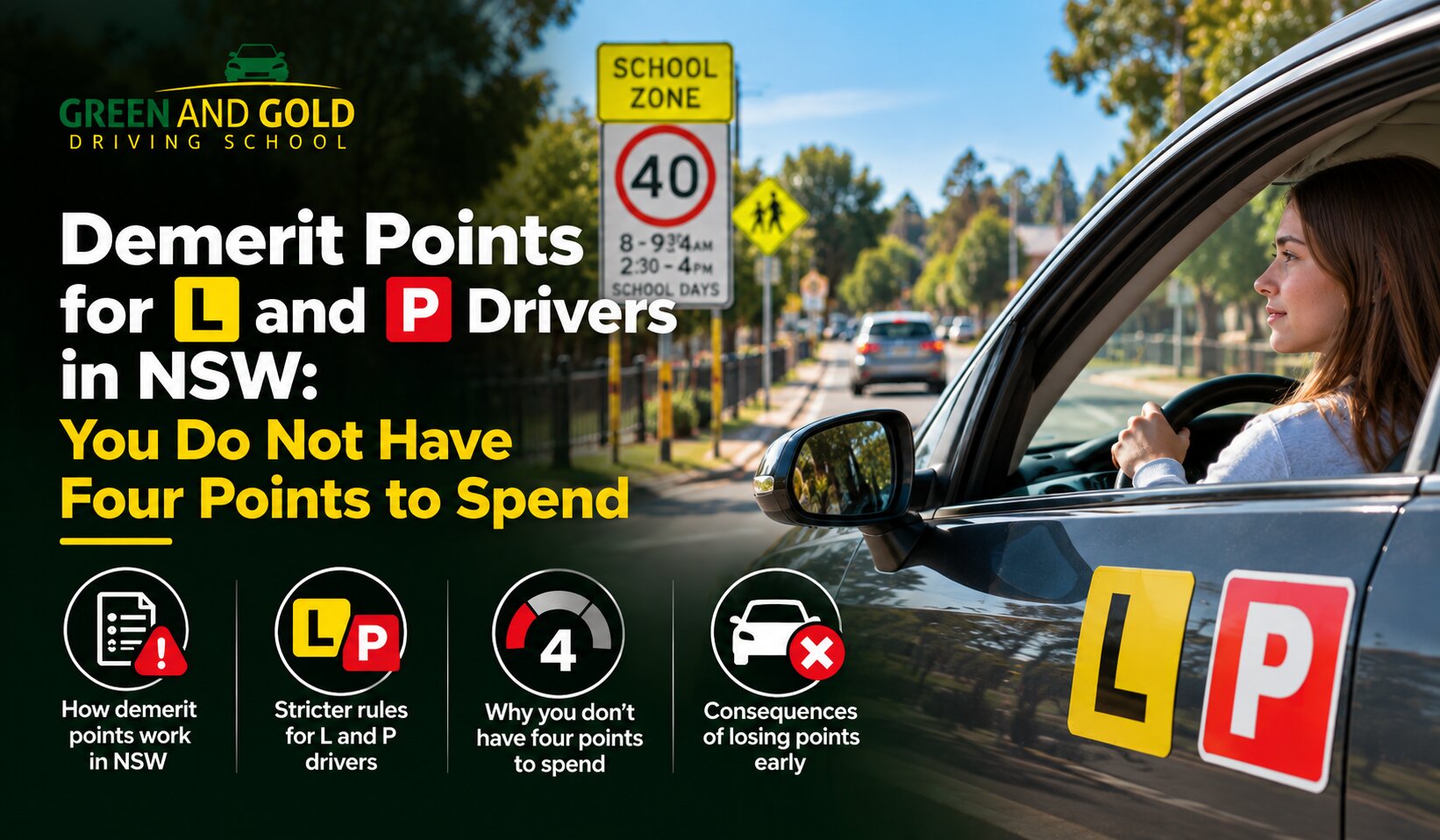
Ask most learner or P plate drivers how many demerit points they have, and they will tell you four. Which is correct, and also completely misleading.
Because of how NSW structures speeding penalties for new drivers, the practical margin on the most common offence of all is zero.
Here is how the system actually works, and why the maths is harsher than it looks.
The thresholds
Your demerit point limit depends on your licence:
| Licence | Limit |
| Learner | 4 points |
| P1 (red Ps) | 4 points |
| P2 (green Ps) | 7 points |
| Unrestricted | 13 points |
Reach or exceed your limit and your licence is suspended. For learner and provisional drivers, that suspension runs for three months.
The part nobody explains properly
Here is the detail that changes everything.
In NSW, a learner or P1 driver receives a minimum of four demerit points for any speeding offence.
Not four points for serious speeding. Four points for speeding, full stop. Even the lowest speed band.
Your limit is four. The minimum penalty for the single most common traffic offence is four.
So you do not have four points to spend. On speeding, you have none. One offence and the licence is gone for three months.
This is the single most important thing a new NSW driver can understand, and almost nobody is told it plainly. The “four point allowance” framing creates a false sense of buffer that does not exist where it matters most.
You cannot take the good behaviour option
Full licence holders who reach 13 points can apply for a 12 month good behaviour period instead of serving the suspension. Stay under two points for that year and the suspension is avoided.
Learner and provisional drivers cannot do this. The option is not available to you.
Full licence holders get a second chance. New drivers serve the suspension. That asymmetry is deliberate, because crash risk in the first years of solo driving is the highest it will ever be, and the system is built around that curve rather than around fairness as most people would define it.
What else gets you there fast
A few offences that can end a provisional licence in one go:
Mobile phone use. L, P1 and P2 drivers cannot use a phone at all, including hands free and GPS. One offence can exceed a four point limit.
School zone offences. Speeding and parking offences inside school zones carry increased points compared to the same offence elsewhere.
Double demerit periods. During declared holiday periods, speeding, seatbelt, phone and helmet offences carry double points. A three point offence becomes six, which is well past a P1 limit and past a P2 limit too.
Exceeding by more than 30 km/h. Provisional drivers caught doing this face immediate suspension and licence confiscation by police at the roadside, separate from the demerit system entirely.
How long points actually last
There is a common misconception worth correcting.
People say demerit points expire after three years. What actually happens is slightly different.
Demerit point offences remain on your driving record permanently. They are never removed. What the three year window governs is which offences can be counted toward a suspension. Only offences committed within a three year period are used when calculating whether you have reached your limit.
So the practical effect for suspension purposes is a rolling three year window from the date of each offence. But your record itself is a record, and it does not wipe clean.
Worth knowing: the demerit point reward trial that returned a point to safe drivers specifically excluded learner and provisional licence holders. The one mechanism that gave points back was never available to the people with the smallest allowance.
What a suspension actually costs you
The three months is not the real cost.
Your progression stops. You cannot accrue the time you need toward your next licence stage while suspended. If you were working to a timeline, it has just moved.
P2 drivers serve longer. A suspension typically extends the P2 period by a further six months before you can progress to a full licence.
Insurance and employment. A suspension on your record affects premiums, and it matters for any job that involves driving.
Against that, the cost of a couple of lessons is modest. We have written before about how structured lessons can save money overall, and avoiding a suspension is the most dramatic version of that.
The habits that keep you under
Treat the limit as the limit, not a target. Speed cameras have tolerances, but they are not generous and they are not published. Driving at the limit means occasionally drifting over it.
Use cruise control in 40 and 50 zones. These are where small drifts happen most, because the speed feels unnaturally slow after an arterial road.
Adjust for conditions. Speed that is legal is not automatically appropriate. In wet weather, the posted limit is frequently too fast, and assessors mark this on the driving test for exactly that reason.
Put the phone away entirely. Not on the seat. Not in a cradle. In the glovebox, before you start the engine.
Know when double demerit periods run. Check the dates before every long weekend.
Build the habits while you still have a supervisor
The learner period is the one stage where a mistake is a conversation rather than a suspension. That is the window to build the habits that keep you under the limit automatically, rather than through constant conscious effort.
Our instructor has spent over 17 years teaching Hills District learners, and speed management is a bigger part of that work than most people expect. Not because learners drive fast, but because judging an appropriate speed for the conditions is a skill, and it is the one that protects your licence for the next decade.
If you are weighing up which instructor to go with, ask how they teach speed management. The answer tells you a lot.
Green and Gold Driving School
Call now: 0422 883 323 Book online: www.greenandgolddriving.com.au Visit us: 18 Victoria Avenue, Castle Hill NSW 2154, Australia
Frequently asked questions
Do demerit points from my learner licence carry over to my P1 licence?
Points sit against your driving record rather than resetting at each licence stage. Offences within the relevant three-year window count toward your current limit.
What happens to my points after I serve a suspension?
The points that triggered the suspension are cleared, so you start the next period fresh. The offences themselves remain on your driving record.
Can I appeal a demerit point suspension?
Learner and provisional licence holders generally have a right to appeal a demerit point suspension in the Local Court, which is a right full licence holders do not have in the same form. Appeals are time-limited, so get legal advice quickly if you intend to lodge one.
Does a parking fine give me demerit points?
Most ordinary parking offences carry a fine without points. Parking offences inside school zones are the notable exception and do carry points.
If I am a learner, can my supervising driver be penalised instead of me?
You are the driver and the offence attaches to you. Separately, a supervising driver can be penalised for their own offences, such as being over the alcohol limit while supervising.
How do I check my current demerit points?
Transport for NSW provides a demerit point check through your online services account. It is worth looking even if you believe you have none, since offences can be recorded without you recalling them.
Do points from interstate offences count in NSW?
Yes. Offences committed in other states are generally transferred to your NSW record.
Is the P2 threshold of seven points much safer?
It gives more room than four, but the minimum four-point speeding penalty for learners and P1 drivers means P2 drivers should not assume the equivalent protection. Two offences can still end a P2 licence.