The Hills District has one of the highest concentrations of schools in Sydney. Drive from Castle Hill through Baulkham Hills, Cherrybrook, Kellyville and West Pennant Hills between 2:30 and 4:00 on a weekday and you will pass through several 40 km/h zones without trying.
Most drivers know the basic rule. Far fewer know the three situations that catch people out, including one where the zone is active and there is not a single student on site.
The basic rule
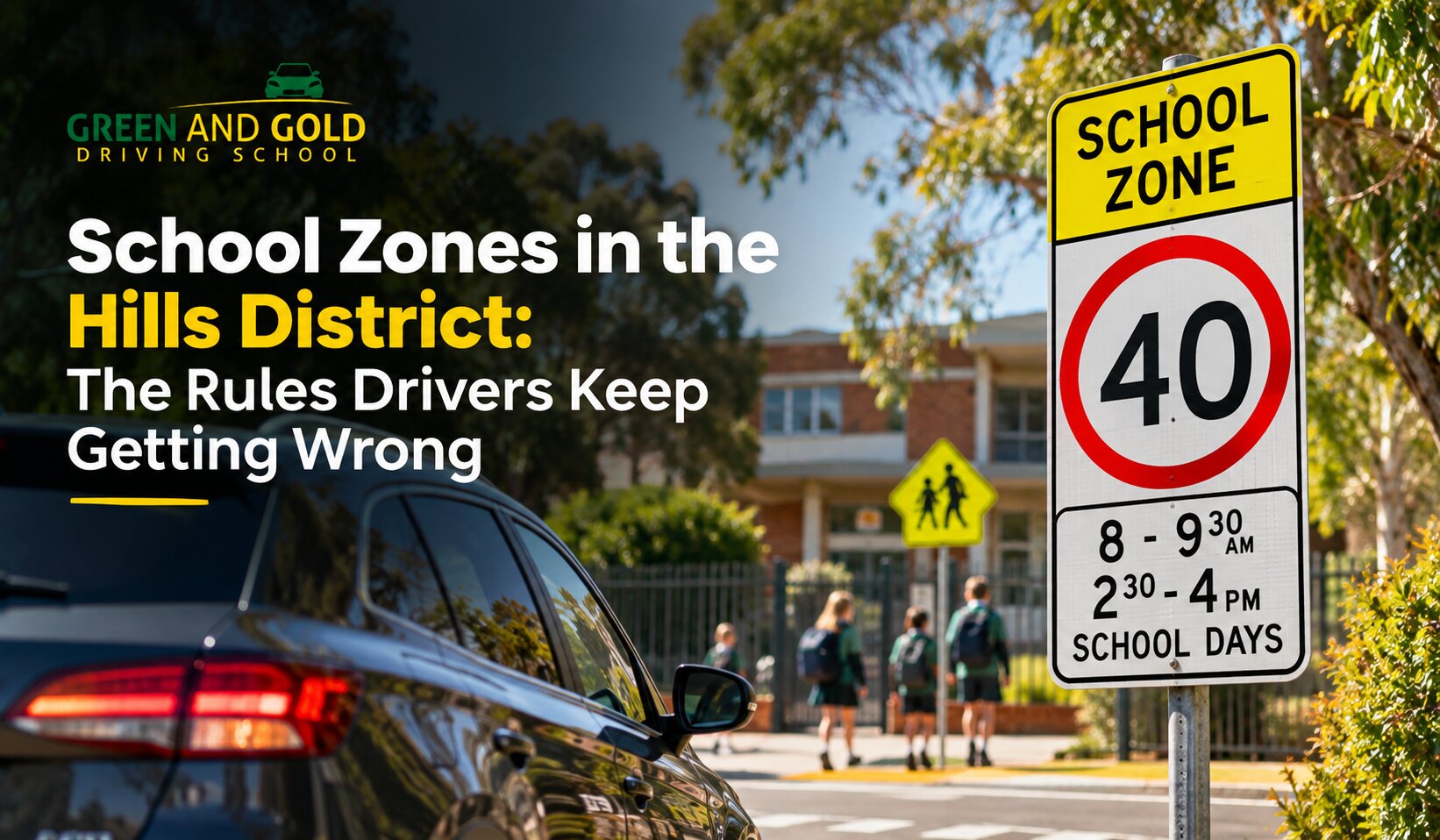
School zones in NSW operate at 40 km/h, usually from 8:00am to 9:30am and again from 2:30pm to 4:00pm.
They apply on all notified school days, which excludes weekends, public holidays and public school holidays.
Every school zone in NSW has at least one flashing light sign, and there are around 6,800 of them across the state. You will also see dragon’s teeth road markings, the triangular white markings painted at the zone boundary.
Rule one: pupil free days are still school zone days
This is the one that surprises people most.
School development days, commonly called pupil free days, are still notified school days. The 40 km/h limit applies at the normal times, because staff are on site and some students may be too.
So a day where your own child is at home is not a day where the zone is switched off. The cameras do not know your child is at home either.
The same applies at the start of each term. Transport for NSW gazettes the school zone start date, and it can be a day or two before students actually return. When Term 3 began in July 2026, zones were active from Monday even though some schools did not have students back until Wednesday.
In an area like the Hills, where several schools sit within a few streets of each other and often return on different days, that gazetted start date is what matters, not what any one school is doing.
Rule two: red or orange signs mean different hours
Most school zone signs are the standard ones showing the usual times.
But a small number of NSW schools operate non-standard hours, and those zones are marked with red or orange school zone signs displaying the specific times for that location.
If you see a coloured sign, read it. Do not assume the times you know from every other school apply. It is a simple visual cue and almost nobody is taught it, which puts it alongside the other road rules most Australian drivers never learn properly.
Rule three: school buses are a separate rule entirely
This one gets confused with school zones constantly, and it is not the same rule.
When a school bus has its lights flashing, you must not drive faster than 40 km/h when passing it. That applies whether the bus is stopped or moving, and it applies regardless of where you are. You do not need to be in a school zone, and the school zone hours are irrelevant.
Around the Hills, school bus routes run well beyond the immediate school precincts, out through Glenhaven, Dural and Kenthurst. The flashing lights are your instruction, not the location.
Why the penalties are heavier here
School zone offences carry increased fines and demerit points compared to the same offence elsewhere. That includes parking offences, not just speeding. Stopping too close to an intersection or a crossing inside a school zone attracts a higher penalty than it would on any other street.
For provisional drivers this matters enormously. P1 drivers have a four point demerit limit. A single school zone offence can wipe out that entire allowance in one go, and the consequences of running out of demerit points are a suspension and a stalled licence progression.
Fixed and mobile cameras operate in school zones, and camera-equipped zones always have flashing lights.
Driving well, not just legally
The rules are the floor. A few things that matter more:
Cruise control is your friend in a 40 zone. Forty feels unnaturally slow after a 60 km/h arterial, and small drifts push you over easily.
Children are unpredictable by design. They step out between parked cars, chase a ball, and misjudge the speed of an approaching vehicle. Their peripheral vision and depth perception are genuinely not yet adult.
Do not stop where you block a sightline. A car stopped in a no stopping zone near a school hides a child from an approaching driver, and hides the driver from the child. That is the entire reason the zone exists.
Never wave a child across. You cannot guarantee the other lane will stop.
For learners and supervising parents
School zone driving is excellent practice, and slightly counterintuitively, it is worth doing deliberately rather than avoiding.
Holding a steady 40 km/h, reading signs under pressure, and managing heavy pedestrian activity are all assessed skills. Speed management on the NSW driving test is marked on whether your speed suits the conditions, not just whether you are under the limit, and a school zone is the clearest test of that there is.
If you are planning practice drives around Castle Hill, build a school zone run into the routine once basic car control is solid. Just do it without a car full of siblings the first time.
Book a lesson
School zones are on almost every test route in the Hills, and they are where nervous learners most often either creep along well under the limit or drift over it without noticing. Both cost marks.
Our instructor has spent over 17 years teaching in this area and knows which school precincts are genuinely difficult at pick up time. A structured lesson with a professional through the Castle Hill and Cherrybrook school corridor at 3pm will teach a learner more about hazard awareness than a month of quiet suburban practice.
Green and Gold Driving School
Call now: 0422 883 323 Book online: www.greenandgolddriving.com.au Visit us: 18 Victoria Avenue, Castle Hill NSW 2154, Australia
Frequently asked questions
Do school zones apply during the school holidays?
No. School zones are not in force on public school holidays, weekends or public holidays. They apply on notified school days only.
What if my child’s school is closed but others nearby are open?
The zone belongs to the school it surrounds, and it operates on gazetted school days. Since Hills schools often have different development days and term start dates, the safest approach is to treat every zone as active during its posted hours throughout the term.
Does the 40 km/h limit apply if I cannot see any children?
Yes. The limit is time-based and day-based, not dependent on whether children are visible. Cameras enforce it either way.
Are all school zones 40 km/h?
Almost all. A small number of zones sit inside high pedestrian activity areas with lower limits, such as parts of Manly where school zones operate at 30 km/h with orange signage. Read the signs.
Do the flashing lights mean the zone is active?
They are a reliable indicator when present and working. But they are a warning aid, not the law. If a light has failed, the zone still applies during its posted hours.
Do school zones apply to cyclists and motorcyclists?
Yes. The speed limit applies to all vehicles.
How do I find out which days are notified school days?
The NSW Department of Education publishes term dates and development days well before each term begins. Transport for NSW also publishes the notified school day calendar.
Does the school bus rule apply on a motorway?
The flashing lights rule applies wherever you encounter a school bus with lights flashing. In practice, this is rare on motorways, but the rule follows the bus rather than the road type.