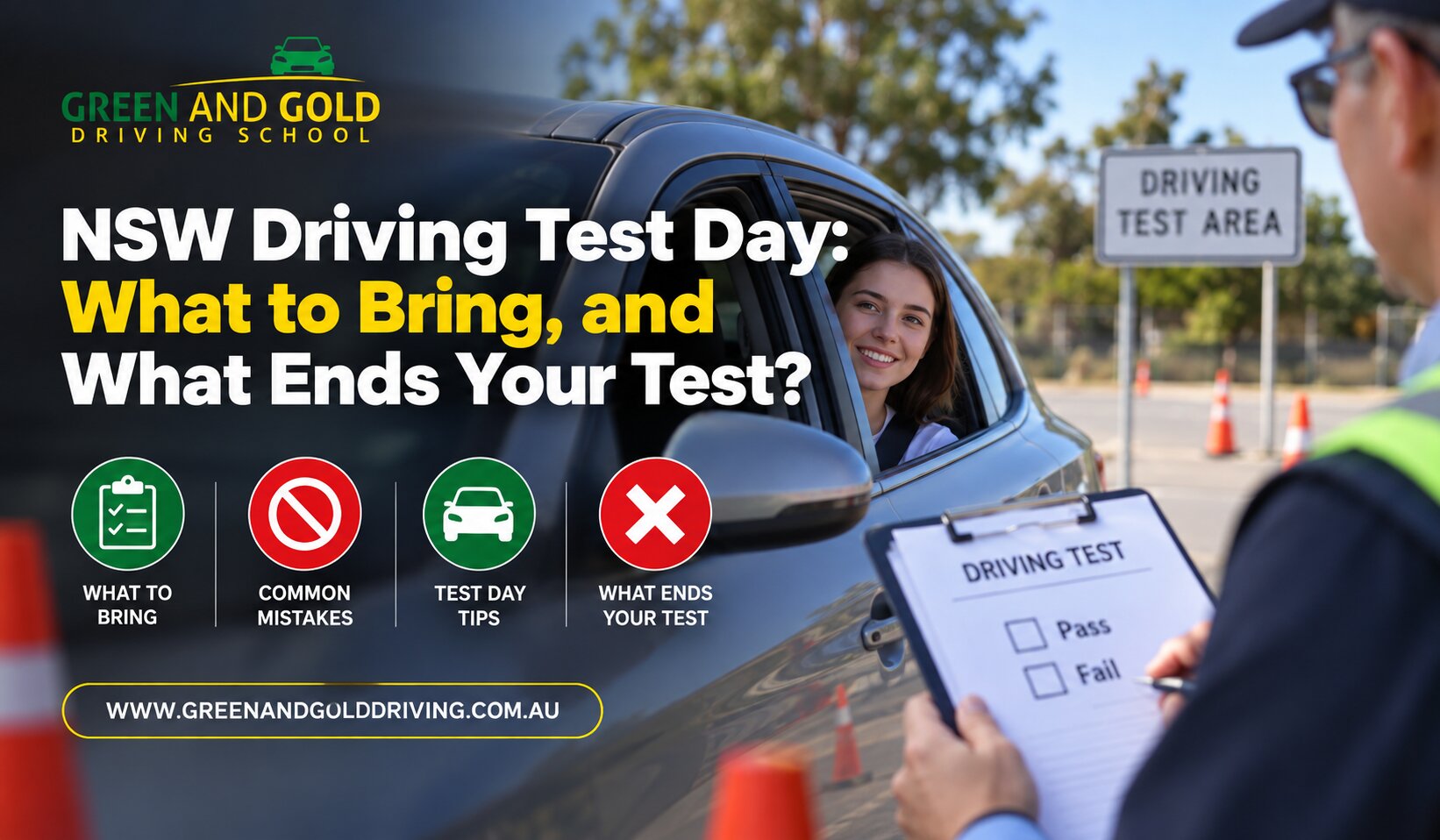
Here is something most learners do not realise until it happens to them. Your driving test can be over before you have driven a single metre, and in some cases the test fee is not refunded.
Not because of your driving. Because of a dirty tail light.
The NSW driving test has a structure that very few people explain properly, and understanding it changes how you prepare. Here is how the whole thing actually works.
Three different ways to fail, and they are not the same
Most articles lump everything together as “instant fails”. The official system has three distinct outcomes, and the difference matters.
Termination happens when something unrelated to your driving stops the test. Almost always the vehicle. The test ends, you do not get assessed, and the fee may not be refunded.
A fail item is a specific error serious enough that you cannot pass. There are 19 of them listed on the score sheet. Importantly, your test continues and you still get a full assessment, so you leave with useful feedback about everything else.
An immediate fail ends the drive on the spot. This is reserved for doing something unsafe that creates obvious danger to the public, or refusing to cooperate with the testing officer. The officer may drive the car back from that point.
One practical consequence worth knowing. The test is officially considered to have started the moment you sign the score sheet, not when you start driving.
The pre-drive vehicle check
Before anything else, the testing officer inspects your car. This is where a surprising number of tests end.
Your vehicle must be registered and roadworthy, and it must be suitable for the class of licence you are testing for.
The specific items that can terminate a test if they cannot be fixed on the spot:
- Indicators or brake lights that do not work, are incomplete, or are dirty or discoloured. Note that wording. A working light behind a filthy or sun-faded lens can still fail. Side repeater indicators count too.
- A cracked or broken windscreen that obscures your view or the testing officer’s view. Minor chips are generally accepted.
- No working seatbelt in the testing officer’s seat. Check the front passenger belt specifically. People check their own and never think about the other one.
- Missing head restraints, for any vehicle manufactured after 1 January 1972.
- A vehicle unsuitable for the licence class you are being tested for.
Beyond that list, the general roadworthiness standard applies. Tyres with legal tread, working horn, functional handbrake, clean mirrors, nothing loose in the cabin.
Do this check the day before, not on the morning of the test. If you find a blown bulb at 8am for a 9am appointment, you have a problem. Find it the night before and it is a trip to the auto parts shop.
If you are using a driving school vehicle, this is all handled for you, which is one of the quieter reasons people book a test car.
What to bring
- Your learner licence
- Your completed logbook, if you are under 25 and required to keep one
- Your glasses or contact lenses, if your licence carries that condition
- A registered, roadworthy vehicle with L plates displayed
- A qualified supervising driver to get you there
- Payment, if the fee has not already been paid
Arrive early. Fifteen minutes is enough to park, use the bathroom, and let your heart rate settle. Arriving with two minutes to spare means starting the test with your pulse already elevated, which affects your judgement more than most people believe.
The 19 fail items, grouped
You do not need to memorise a numbered list. They cluster into five themes.
Disobeying signs, signals and markings. Running a red light, not stopping at a yellow when it was safe to do so, stopping past the stop line or more than a metre short of it, ignoring a give way sign.
Observation errors. No head check before a lane change, merge or pull out. Mirrors alone do not satisfy this. Assessors watch for the physical shoulder check specifically, and it is the single most commonly recorded fault.
Signal errors. Not signalling, signalling too late, or leaving an indicator on after a manoeuvre.
Following too closely. Tailgating is explicitly a fail item. Keep the three second gap and do not let it erode in traffic.
Dangerous or discourteous behaviour. Cutting drivers off, forcing gaps, aggressive responses. Also any crash during the test, regardless of fault or severity.
We have written separately about the broader reasons learners fail, and it is worth reading alongside this, because most failures come from habits rather than one dramatic moment.
What is actually being scored
Your drive is broken into a series of assessment zones. In each one, the testing officer marks you across five areas:
- Speed management
- Road positioning
- Decision making
- Responding to hazards
- Vehicle control
The official guide sets a high pass threshold, commonly cited as 90 per cent of the assessed criteria, with no fail items recorded.
But chasing a percentage is the wrong mental model. The score reflects consistent low-risk driving across the whole drive. You cannot bank marks early and coast. Drivers who pass comfortably tend to be the ones doing ordinary things correctly every single time, not the ones performing.
You will also be asked to complete low-speed manoeuvres. These vary, but the reverse parallel park is the one learners worry about most. Worth remembering that on manoeuvres, the observation is marked more heavily than the steering. A slightly untidy park with thorough checks scores better than a perfect one done blind.
Small things that cost marks quietly
These are not fail items, but they erode your score:
- Sitting too far back from the wheel, which limits steering control
- Drifting wide on left turns
- Braking late and hard rather than early and smooth
- Coasting in neutral, or riding the clutch in a manual
- Not looking far enough ahead, so every hazard is a reaction rather than an anticipation
- Hesitating at a clear roundabout or intersection, which is marked as poor decision making
Many of these are habits formed during practice that nobody corrected, because the supervising driver stopped noticing them months ago.
About the nerves
Nearly everyone is nervous. Testing officers expect it and they do not mark you down for it.
What they do mark is what nerves cause. Rushing decisions. Fixating on the car in front. Forgetting head checks because your working memory is full.
Two things genuinely help. First, familiarity with the format, which is why a mock test run under real conditions is worth more than another hour of general practice. Second, sleep. A tired brain makes slower decisions, and test day is not the morning to run on five hours.
If nerves around driving are a bigger issue for you than technique, that is worth addressing before you book, not after.
The week before your test
This is where a lesson or two earns its keep.
In the final week, the useful work is not learning new skills. It is a full rehearsal under test conditions, so an instructor can tell you honestly whether you are ready, and fix the two or three specific habits that would cost you.
Our instructor has spent over 17 years preparing Hills District learners for exactly this, and can run you through a test-standard drive plus the vehicle check, so nothing on the day is a surprise.
Book a session for the week before your test, not the day before. You want time to work on whatever comes up.
Green and Gold Driving School
Call now: 0422 883 323 Book online: www.greenandgolddriving.com.au Visit us: 18 Victoria Avenue, Castle Hill NSW 2154, Australia
Frequently asked questions
Can I use my own car for the driving test?
Yes, provided it is registered, roadworthy, suitable for the licence class and passes the pre-drive check. Many learners use a driving school car instead, since the vehicle requirements are guaranteed to be met.
What happens if my test is terminated over a vehicle problem?
The test does not proceed and the fee may not be refunded. You rebook and pay again. This is why the vehicle check the night before matters so much.
Does a fail item end the test immediately?
No, and this surprises people. If you record a fail item, the drive usually continues so you receive a complete assessment. You will not pass, but you get a detailed score sheet showing exactly what to work on.
Do I get to see my score sheet?
Yes. You receive a copy, and the officer explains the result. Whether you pass or not, it is the most useful practice document you will ever have, so bring it to your next lesson.
Is the test harder in a manual?
The criteria are identical, but a manual adds stalling, gear selection and clutch control to the list of things that can go wrong. That is worth factoring in when choosing which transmission to test in.
Can I memorise the test route?
There are common routes around each centre, but conditions change and officers vary the directions. Memorising a route gives false confidence. Being genuinely comfortable on the type of roads around your test centre is what helps.
What happens if I fail?
You rebook and sit it again. There is a waiting period between attempts and a fee each time. Use the score sheet to target your preparation rather than simply booking again and hoping.
Will the testing officer try to trick me?
No. Officers give clear directions and will repeat them. If you miss a turn, that is not a fail in itself. Just keep driving safely and follow the next instruction.
Should I have a lesson on the morning of the test?
A short warm-up drive beforehand helps many learners settle, particularly if you are using an unfamiliar car. A full lesson on the morning is usually too much, and cramming new corrections into the last hour tends to backfire.